



Overview
Our Virtual Private Server (VPS) platform provides flexible, high-performance virtual machines designed for application hosting, development environments, and general-purpose workloads.
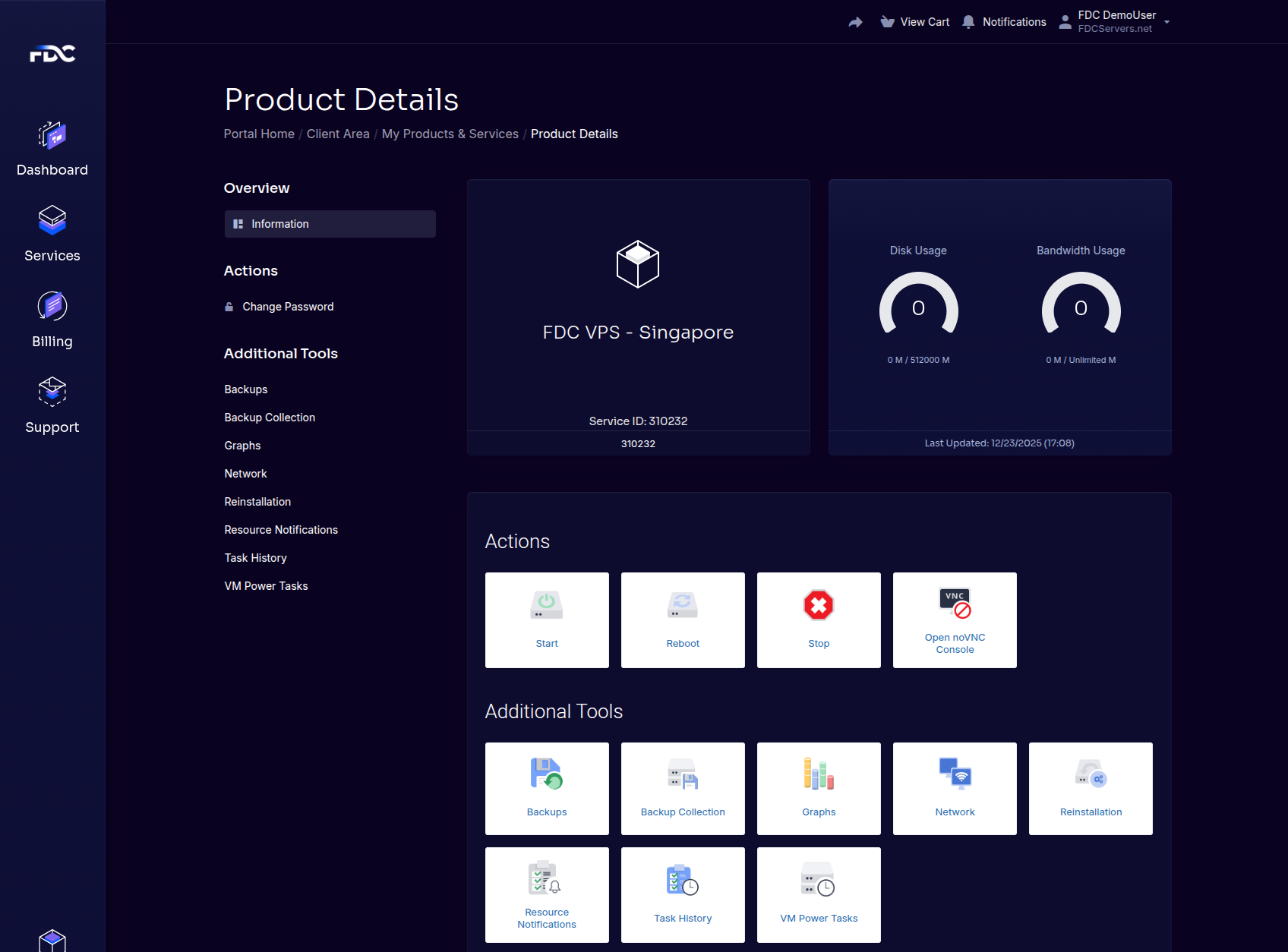
Instances are provisioned on a clustered virtualization platform with fast NVMe-backed storage, built-in high availability, and self-service management through the client portal.
Provisioning is near-instant for Linux templates, with additional options available for custom installations.
What Is an Instance?
An instance (also referred to as a VPS) is a virtual machine with dedicated, guaranteed resources running on shared physical infrastructure.
Each instance includes:
-
Guaranteed RAM
-
Allocated vCPU resources (shared)
-
NVMe-backed storage
-
Network connectivity with unmetered, rate-limited bandwidth
-
Full administrative access
Instances are isolated from one another and can be independently started, stopped, rebooted, and reinstalled.
Platform Architecture (High-Level)
Our VPS platform is built to balance performance, flexibility, and resilience:
-
Virtualization: Hardware-assisted virtualization (KVM)
-
Storage: Distributed NVMe-backed storage
-
Compute: Shared CPU, guaranteed RAM
-
Networking: Unmetered traffic, rate-limited per plan
-
Availability: Automatic host failure recovery and live migration
Advanced
Storage is provided by a replicated NVMe cluster. This offers strong durability and flexibility, but latency characteristics may differ slightly from single-host local NVMe. For most workloads this is negligible, but extremely latency-sensitive applications should be designed accordingly.
Performance Expectations
CPU
-
CPU resources are shared across the platform
-
Instances are not aggressively oversubscribed
-
Short-term CPU bursts are expected to perform well
-
Sustained CPU saturation may be throttled to maintain platform stability
???? Advanced
CPU scheduling prioritizes fairness and platform health. Instances requiring sustained, guaranteed CPU performance may be better suited to dedicated servers.
Memory (RAM)
-
RAM is guaranteed
-
No memory overcommit is used
-
Swapping behavior is controlled by the guest operating system
Storage
-
All instance storage is backed by NVMe
-
Storage is resilient to host failures
-
Disk performance is consistent across instances of the same plan
⚠️ Important
While storage is highly available, it does not replace application-level data protection or off-platform backups.
Networking
-
Traffic is unmetered
-
Bandwidth is rate-limited per plan
-
Entry-level plans start at 10 Mbps
-
Larger plans scale up to 20+ Gbps
???? Advanced
Sustained traffic at the plan’s maximum rate is allowed. Traffic patterns that negatively impact the platform may be restricted without notice.
Availability & Reliability
The platform is designed to tolerate hardware failures:
-
Automatic recovery is performed if a host fails
-
Instances may be restarted or migrated automatically
-
Live migration is used whenever possible to minimize disruption
???? Advanced
Live migration requires functional guest tools within the instance. Misconfigured or unsupported operating systems may limit migration capabilities.
⚠️ Note
High availability protects against infrastructure failures, not guest OS issues or application-level failures.
What the Platform Does Not Provide
A VPS instance does not include:
-
Application-level redundancy
-
Managed operating system administration
-
Guaranteed zero downtime
-
Protection against misconfiguration or data deletion
Customers are responsible for designing resilient applications and maintaining appropriate backups for critical data.